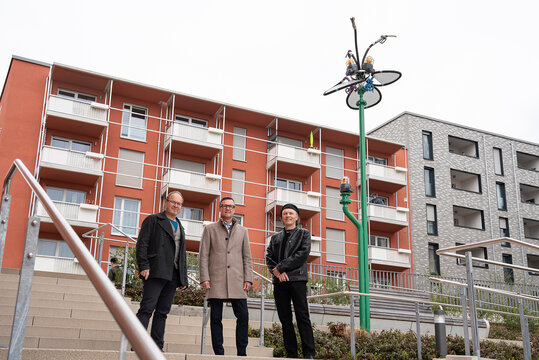
The development of the “monopol491” residential neighborhood continues the history of the former site of the Federal Monopoly Administration for Spirits in a unique way. To prepare the site for new residential development, the existing industrial buildings were largely demolished. However, as part of the public participation process, a desire was expressed early on to visibly preserve the site’s past—under the guiding principle “History Remains.”
Consequently, the building at the center of the neighborhood was preserved, and numerous artifacts from its former use were secured. These historical elements formed the basis for an art-in-architecture project that transfers the site’s identity into the new residential complex.
In consultation with the Advisory Board for Fine Arts of the City of Nuremberg and the Professional Association of Visual Artists of Nuremberg and Middle Franconia e. V., five artists were selected for an invited competition. A jury of experts, consisting of representatives from the fine arts community and members of the BBK board, evaluated the submitted designs. Managing Director Ralf Schekira served as a technical judge on behalf of wbg Nuremberg. The aim of the competition was to create new, permanent works of art from the preserved remnants of the site’s former use, works that would convey the history of the location in a contemporary form.
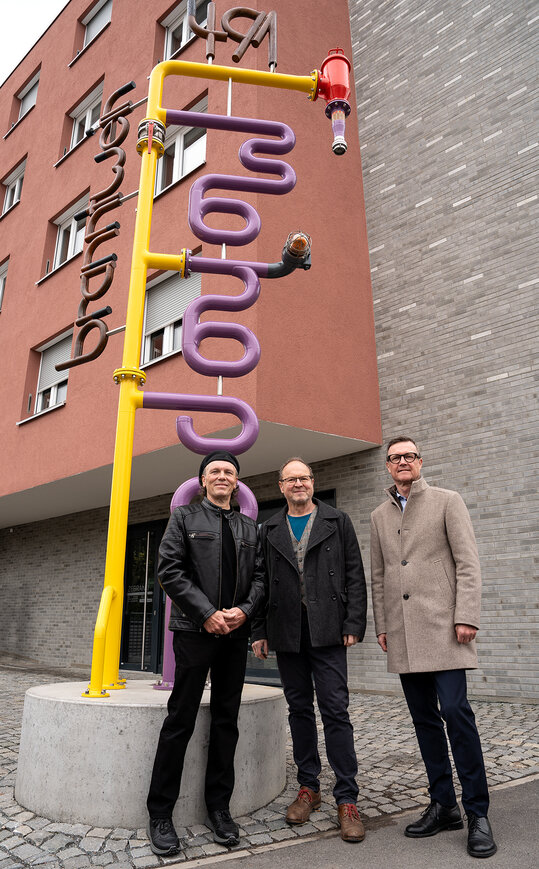
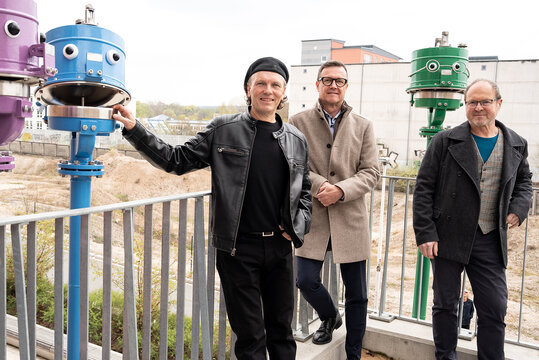
At the jury meeting on July 21, 2025, the design by the artist duo Karl Schnell and Klaus-Leo Drechsel was awarded first prize. Under the title “Bunte Köpfe Stahl Gewächse” (Colorful Heads, Steel Plants), three independent works of art were created that engage with the historical materials in a playful yet striking manner.
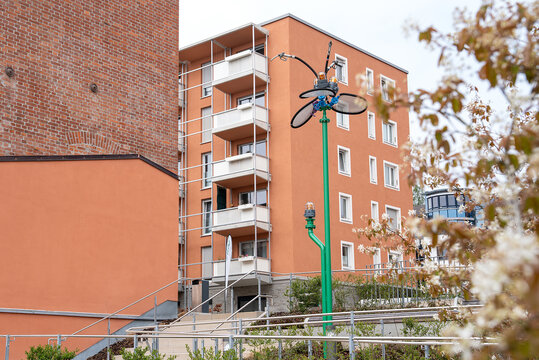
The jury particularly praised the creative reinterpretation of the found objects: pipes are assembled into a new, large-scale neighborhood emblem; technical elements such as warning lights and gate valves are transformed into a sculptural plant; and spark arrestors are reimagined as colorful heads. Taken as a whole, the works connect the past and the present in a surprising yet identity-forming way.
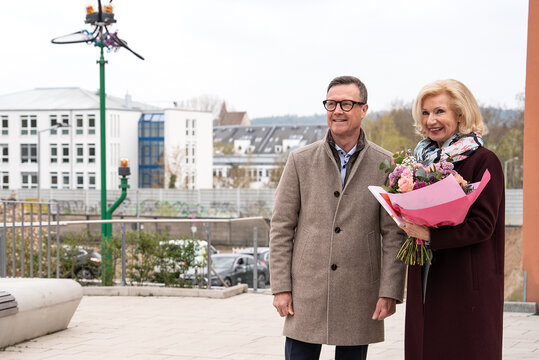
During the ceremonial unveiling, Julia Lehner, the city’s mayor for culture, emphasized: “The promotion of art and culture has been part of wbg’s DNA for many decades. I am all the more pleased that several special works of art have been created in this new neighborhood, making history visible and enriching the place.”
Daniel F. Ulrich, City Councilor for Planning and Construction, also underscored the importance of art in urban spaces: “Art in architecture is an important contribution to the quality of our city. It creates identity and makes neighborhoods livable and lovable. The fact that wbg remains committed to this goal even under challenging conditions sends a strong signal.”
For wbg Managing Director Ralf Schekira, the unveiling also marks an important project milestone: “With the completion of the artworks, we are concluding the first major construction phase in the monopol491 neighborhood. In keeping with our mission to design living spaces, more than just housing is being created here: The artworks give the neighborhood its own character and invite people to engage with the place and its history.”
A brochure has been produced to accompany the artworks, documenting the creative process and providing background information on the works. It is available through wbg Nürnberg’s corporate communications department.